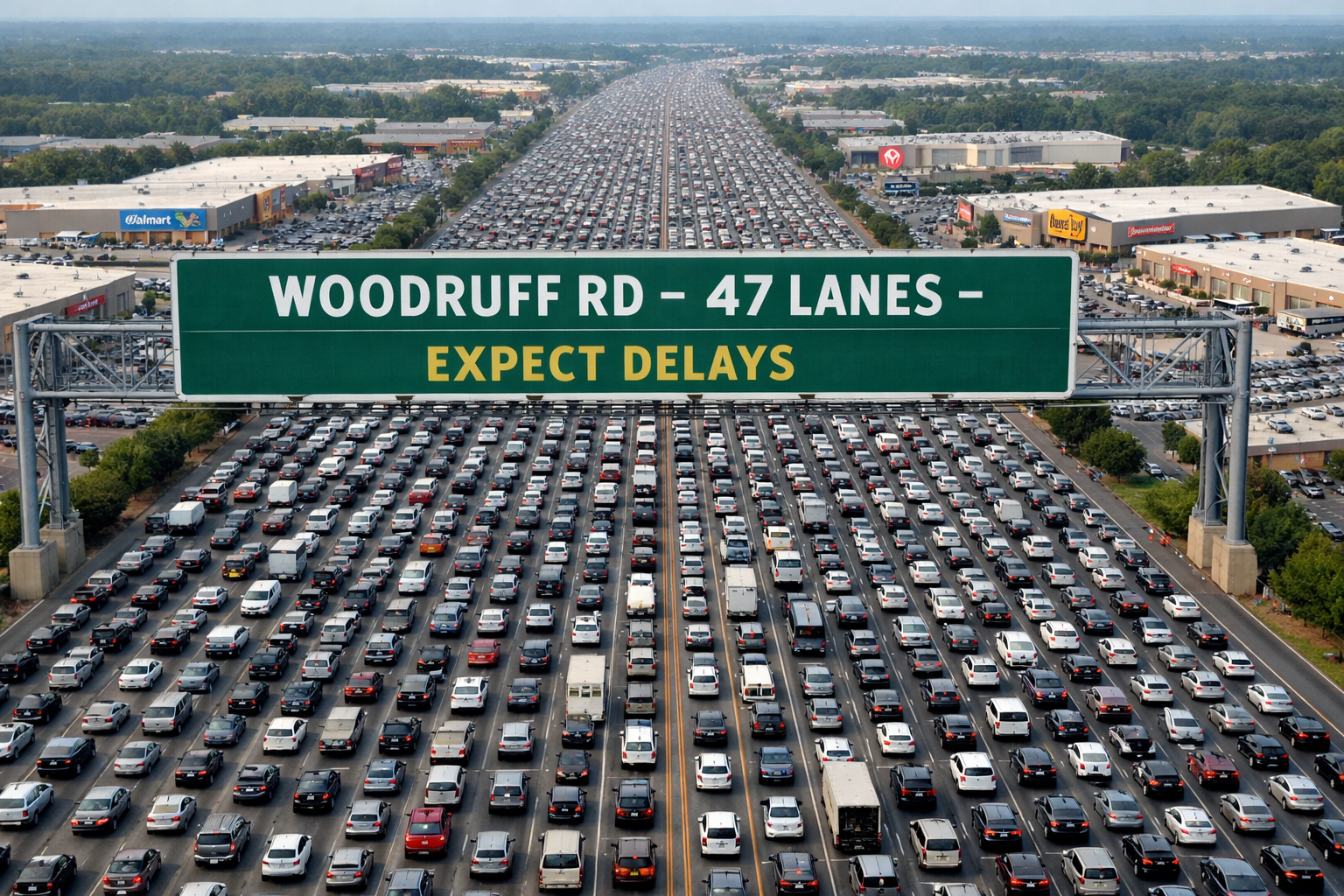
GREENVILLE — In an ambitious infrastructure project that transportation officials describe as "our most desperate attempt yet," Woodruff Road will soon expand from its current 6 lanes to 53 lanes, making it the widest road in the Western Hemisphere and almost certainly still gridlocked during lunch hours.
"We've tried everything else," said SCDOT engineer Michael Torres, gesturing at blueprints that appeared to be drawn in crayon. "More turn lanes. Synchronized lights. Thoughts and prayers. Nothing works. So we're just going to add lanes until something happens."
The $4.7 billion project will require the demolition of only three shopping centers, which will be immediately rebuilt as larger shopping centers accessible exclusively via the new lanes.
"Traffic studies show this will reduce average commute times from 45 minutes to 44 minutes. We're calling it a victory."
Woodruff Road, a 5-mile stretch connecting I-85 to I-385 through Greenville's most concentrated retail corridor, has long been considered the most frustrating driving experience in the Upstate. The road features 847 traffic lights, 12,000 parking lot entrances, and an Olive Garden that somehow causes a backup visible from space.
"We ran computer simulations on the 47-lane design," said traffic analyst Dr. Rebecca Foster. "The models kept returning error messages that just said 'LOL' and 'Good luck.' We're choosing to interpret that as cautious optimism."
Local business owners expressed mixed reactions to the expansion.
"I support anything that brings more customers," said Dave Chen, owner of one of Woodruff Road's 340 restaurants. "Though I'm not sure how anyone will cross 53 lanes to reach us. We may need to install a zip line."
The project will also introduce "Woodruff Road Premium Lanes" — toll lanes that cost $75 per use and promise to reduce travel time by up to 90 seconds. "It's for people who really need to get to Target," Torres explained.
Construction is expected to take 12 years and cause delays that officials describe as "indistinguishable from current conditions."
When asked if the project would actually solve traffic problems, Torres paused for a long moment. "No," he admitted. "But at this point, we're committed to the bit."
A public comment period is open through January 15th, though officials note they "probably won't read any of it."